



Ecofeminism
Glossary
Ecofeminism is a global school of thought and movement which has proliferated transnationally since the 1970s, and has received renewed attention in the context of the current climate crisis. Simply put, ecofeminists view the oppression based on gender and the destruction of nature as inextricably intertwined, and as part of a social system of intersecting injustices. In Ecological Feminism (1991), the American ecofeminist Karen Warren argued that “the exploitation of nature and animals is justified by feminizing them; the exploitation of women is justified by naturalizing them.”
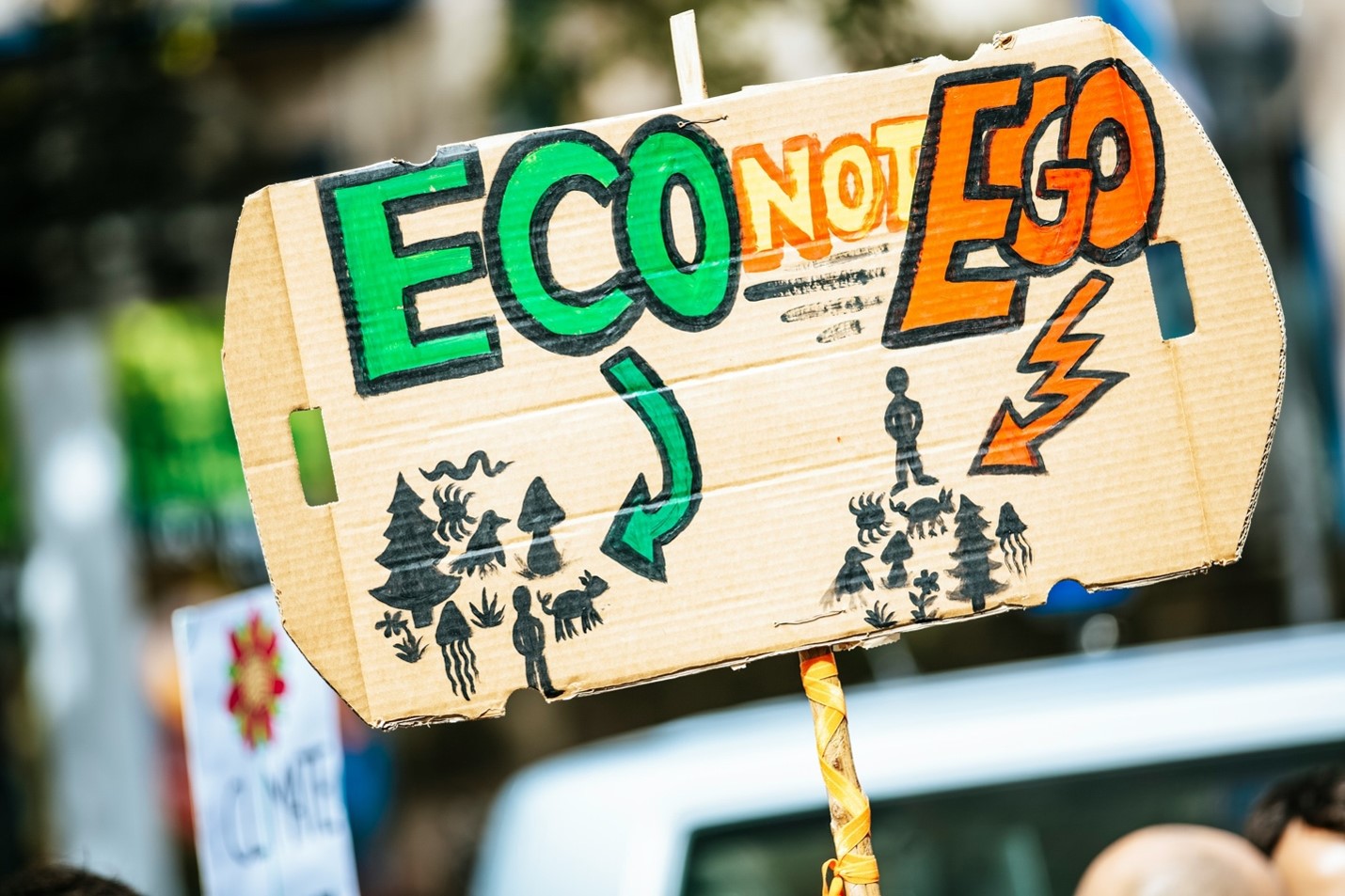
The term ecofeminism was first coined by the French environmental activist and feminist Françoise d'Eaubonne, who, in her groundbreaking book Le féminisme ou la mort (Feminism or Death, 1974), called upon women to lead the ecological revolution and to champion the reimagining of the connections between humanity and nature, and between men and women. To her, merging a feminist and ecological worldview was the only way to radically rethink our relationship with the planet and each other.
Ecofeminists argue that we have to transition from a mindset of anthropocentric hierarchy and domination to ecocentric narratives of symbiosis, collaboration and intrinsic interconnectedness. Gender is an important factor here, because a separatist, hierarchical and mechanistic worldview of unfettered progress has historically exploited both women and natural resources, and the devaluation of previously “female-associated” qualities (irrationality, wildness, volatility, etc.) has also been extended to migrants and minorities, indigenous people, queer and LGBTQIA+ people, as well as non-human species such as animals and plants.
Survival on the planet therefore requires the deconstruction of domination narratives (variously identified as “domination culture” by Riane Eisler and “the Master Model” by Val Plumwood), by “piecing together the fragmented worldview we have inherited and the reweaving of all the old stories and narratives into a multifaceted tapestry,” according to Marti Kheel.

It is important to emphasize that ecofeminism is an incredibly diverse movement, which has taken on various manifestations in its respective cultural contexts, from France and Germany to North America, Africa, Asia and Latin America. The multifold historical transformations of ecofeminism have been accompanied by controversies and misunderstandings. A group of ecofeminists who were later categorized as “cultural ecofeminists”, such as Mary Daly, Susan Griffin and Charlene Spretnak, espoused essentialist and binary views on gender in the 1990s, in which women were considered closer to nature, their roles as mothers were extolled, and earth-based goddess spiritualities were embraced. The reactionary and Eurocentric tendencies of this group led to the disavowal of the term ecofeminism by subsequent generations of ecological theorists who emphasized a materialist, intersectional and non-binary view of ecofeminist principles. In contrast to cultural ecofeminists, posthumanist, new materialist and socialist ecological feminist thinkers such as Donna Haraway, Stacy Alaimo; Vandana Shiva and Ariel Salleh highlight the interconnectedness and interdependence of all life through concepts such as entanglement, transcorporeality, nature-culture and a reconceptualization of what constitutes kinship while firmly situating their observations firmly within socio-political and historical power structures. Drawing, for example, on insights from quantum physics, materialist and posthumanist ecofeminist thinkers such as Karen Barad and Jane Bennett also highlight the agentiality and aliveness of all matter, from sentient beings to waterways and even seemingly inanimate rocks.
Within LIMINALWATER, applying an ecofeminist analysis from an interdisciplinary perspective, that is, not just to literature and the arts, but also history, human geography, sociology and anthropology, has been deeply enriching. This approach has not implied a mere imposition of ecofeminist ideas onto academic case studies, but has rather encouraged all team members to shift away from both anthropocentric and patriarchal views of life on earth by thinking ecology as inherent even in subjects that have seemingly little to do with it (ie., social injustice or interreligious dialogue), as well as highlighting aspects of relationality, interdependence, and collaboration.
Sources:
Alaimo, Stacy. Undomesticated Ground: Recasting Nature as Feminist Space. Ithaca, NY: Cornell University Press, 2019
Barad, Karen. Meeting the Universe Halfway Quantum Physics and the Entanglement of Matter and Meaning. Durham: Duke University Press, 2007.
Bennett, Jane. The Enchantment of Modern Life: Attachments, Crossings, and Ethics. Princeton University Press, 2016.
Daly, Mary. Gyn/Ecology: The Metaethics of Radical Feminism. Beacon Press: Boston, 1978.
D’Eaubonne, Françoise. Le Féminisme Ou La Mort. Myriam Bahaffou, Julie Gorecki, eds. Paris: le passager clandestin, 2020.
Eisler, Riane. The Chalice and the Blade. London: Thorsons, 1998.
Griffin, Susan. The Eros of Everyday Life : Essays on Ecology, Gender and Society. New York: Anchor Books, 1995.
Haraway, Donna. Staying with the Trouble: Making Kin in the Chthulucene, Durham: Duke University Press, 2016.
Kheel, Marti. Nature Ethics: An Ecofeminist Perspective. Alexandria: Alexander Street Press, 2019.
Plumwood, Val. Feminism and the Mastery of Nature, London: Routledge, 2015.
Salleh, Ariel. Ecofeminism as Politics: Nature, Marx and the Postmodern. London: Zed Books and New York: St Martins Press, 1997.
Shiva, Vandana and Maria Mies. Ecofeminism. Highlands: Zed Books 1993.
Spretnak, Charlene. The Politics of Women's Spirituality. Essays by Founding Mothers of the Movement. New York: Anchor Books, 1994.
Warren, Karen. Ecological Feminism. London: Routledge, 1991
Date: 29. 6. 2026.