Begin of page section:
Page sections:

  • Go to contents (Accesskey 1)
  • Go to position marker (Accesskey 2)
  • Go to main navigation (Accesskey 3)
  • Go to sub navigation (Accesskey 4)
  • Go to additional information (Accesskey 5)
  • Go to page settings (user/language) (Accesskey 8)
  • Go to search (Accesskey 9)

End of this page section. Go to overview of page sections

Begin of page section:
Page settings:

English en
Deutsch de
Search
Login

End of this page section. Go to overview of page sections

Begin of page section:
Search:

Search for details about Uni Graz
Close

End of this page section. Go to overview of page sections


Search

Begin of page section:
Main navigation:

Page navigation:

  • University

    University
    • About the University
    • Organisation
    • Faculties
    • Library
    • Working at University of Graz
    • Campus
    Developing solutions for the world of tomorrow - that is our mission. Our students and our researchers take on the great challenges of society and carry the knowledge out.
  • Research Profile

    Research Profile
    • Our Expertise
    • Research Questions
    • Research Portal
    • Promoting Research
    • Research Transfer
    • Ethics in Research
    Scientific excellence and the courage to break new ground. Research at the University of Graz creates the foundations for making the future worth living.
  • Studies

    Studies
    • Prospective Students
    • Students
  • Community

    Community
    • International
    • Location
    • Research and Business
    • Alumni
    The University of Graz is a hub for international research and brings together scientists and business experts. Moreover, it fosters the exchange and cooperation in study and teaching.
  • Spotlight
Topics
  • Sustainable University
  • Researchers answer
  • Work for us
Close menu

End of this page section. Go to overview of page sections

Begin of page section:
You are here:

University of Graz Liminalwater Blog Blog Archive From Vienna to Bratislava: Verses of Water
  • Projects
  • Team
  • Blog
  • News
  • Events

End of this page section. Go to overview of page sections

Begin of page section:
Sub navigation:

  • Projects
  • Team
  • Blog
  • News
  • Events

End of this page section. Go to overview of page sections

From Vienna to Bratislava: Verses of Water

Field Notes

On January 15, 2021, the Austrian poet Friederike Mayröcker, at that time 96 years old, finished and dated her last lyric work. In the 22 verse long untitled poem, she writes about friendship and death, arrival and departure, all enabled and connected by the river Danube. On a gloomy autumn day in October 2025, my best friend and I traveled this same waterway from Wien Schwedenplatz to Bratislava, just as the first-person narrator—possibly Mayröcker herself—had done with her friend a few years earlier. We followed Mayröcker’s way on the water to better understand her story, to better understand the many stories water holds for us.
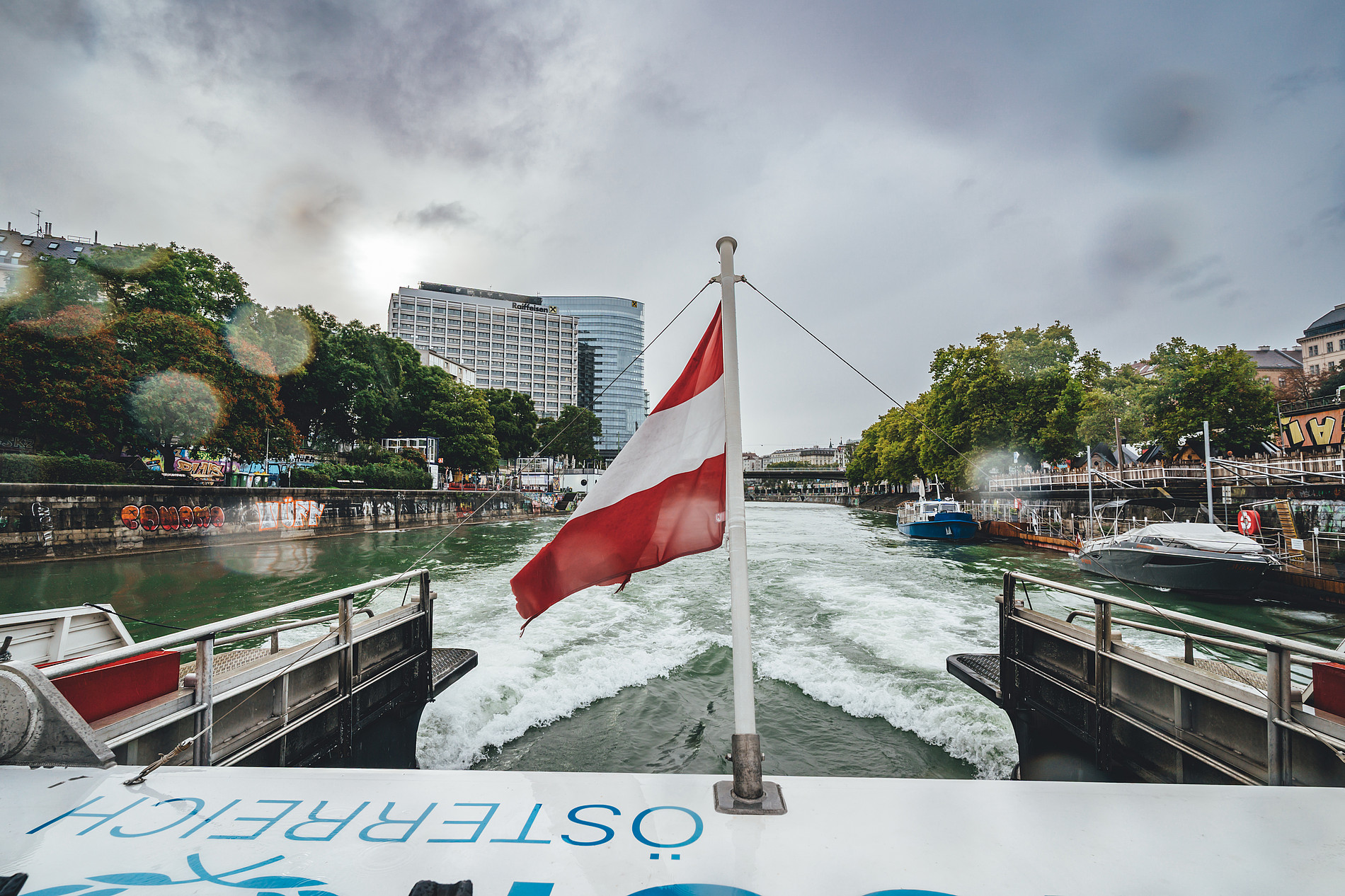
Austrian flag on a boat sailing down a city river, with modern buildings, trees, and other boats visible under a cloudy sky. ©Manuel Madaini
©Manuel Madaini
In the wake of Friederike Mayröcker – leaving Vienna and following her last poem.

Traveling to Bratislava on the Danube, our journey was more than a means of passage. While the current carries us onward, the river is witness to centuries of crossings reminding us of its enduring connectivity and the relational life of the river itself.

Moving along with the water allowed us to experience it not only as liminal space but also as mediating force.
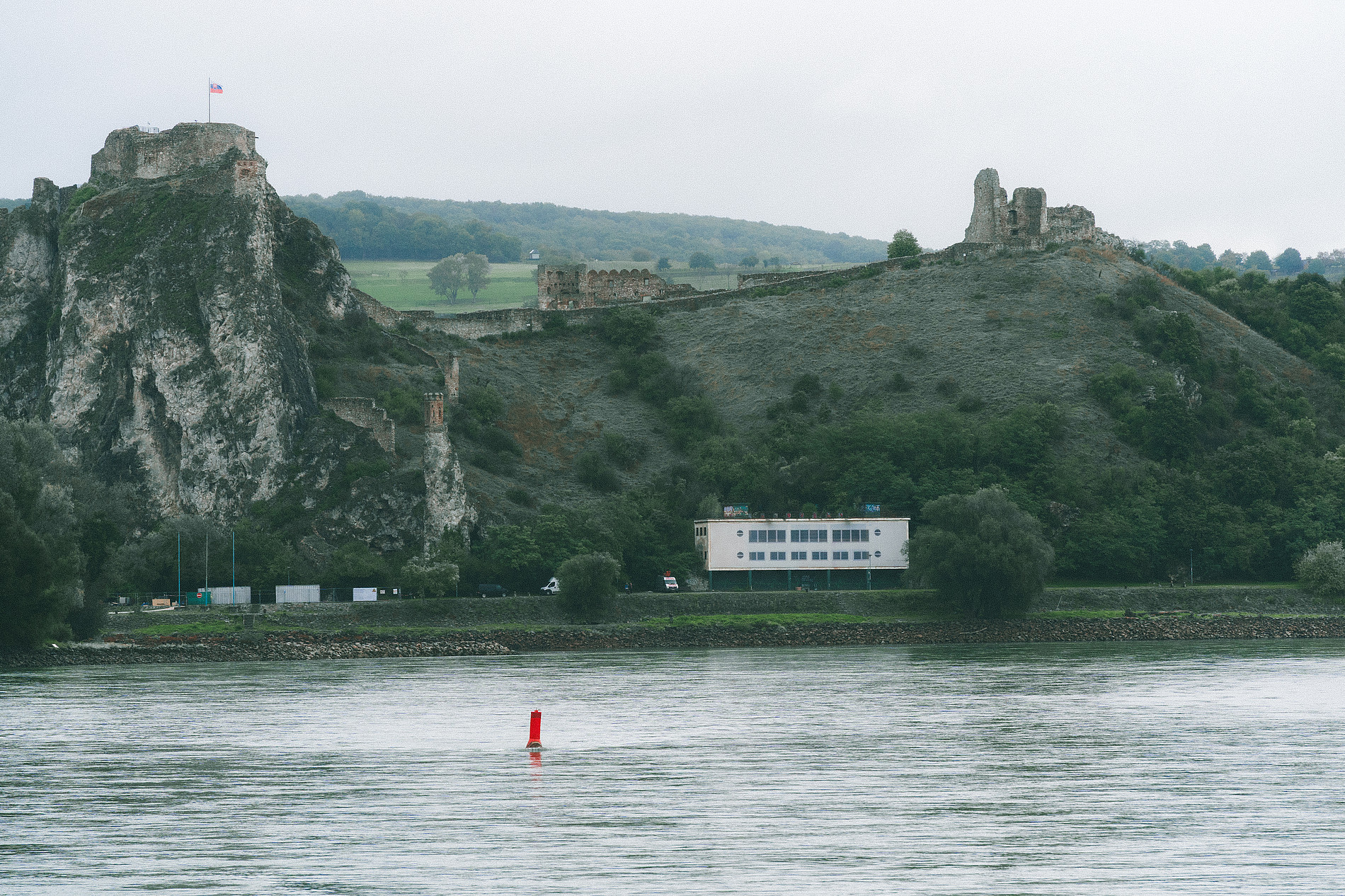
Danube River and Castle Devín ©Manuel Madaini
©Manuel Madaini
Drifting down the Danube, we glide by Maiden Tower of Castle Devín

The journey aligned with my research on multiple levels as I seek to answer questions on how rivers mediate different perspectives on history, allow movement from one place to another, and share knowledge otherwise hidden by temporal, geographic, and cultural thresholds.

Having arrived in Bratislava, water did not leave us when we stepped off the boat, just as it never leaves Mayröcker’s poem—at any moment, in any verse.
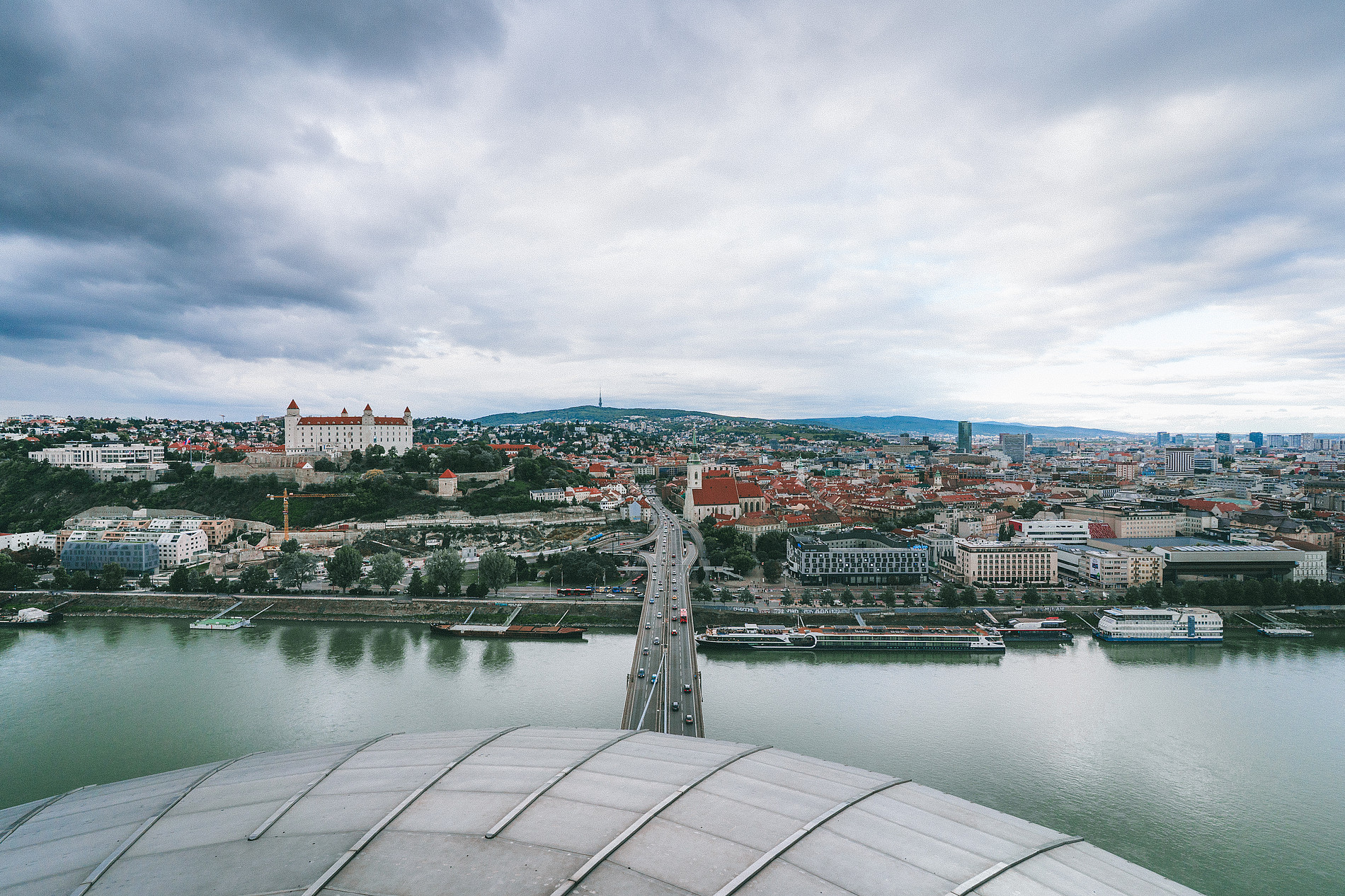
Panoramic view of a European city along a wide river under a cloudy sky. A bridge stretches across the water toward a historic old town with red-roofed buildings and a prominent castle perched on a hill to the left. Church spires rise among dense city blocks, while modern buildings stand farther in the background. Boats are docked along the riverbanks, and the foreground shows the curved roof of a structure overlooking the scene. ©Manuel Madaini
©Manuel Madaini
Looking at Staré Mesto, Bratislava’s Old Town, and Most Slovenského národného povstania (Bridge of Slovak National Uprising) from UFO Tower

At Bratislava City Gallery we visited Till the Water Meets the Shore –– a presentation of Kven Nguyen’s exploration of memory, migration, and the fragile afterlives of history. Drawing on archival research, moving image, photography, sculpture, and installation, Nguyen traced the trajectory of the Vietnamese diaspora in Central Europe from post-war migration shaped by socialist internationalism, through the political and social rupture of the Velvet Revolution (1989), to discrimination. Rather than offering a linear historical account, Nguyen’s tale unfolded poetically, allowing fragmented voices to surface gradually.

Water in this exhibition functioned as a central metaphor for moving bodies across borders, flooding them in slow waves of experience. It also stands for the fluidity of memory over time, flowing and shifting with the current and tide.
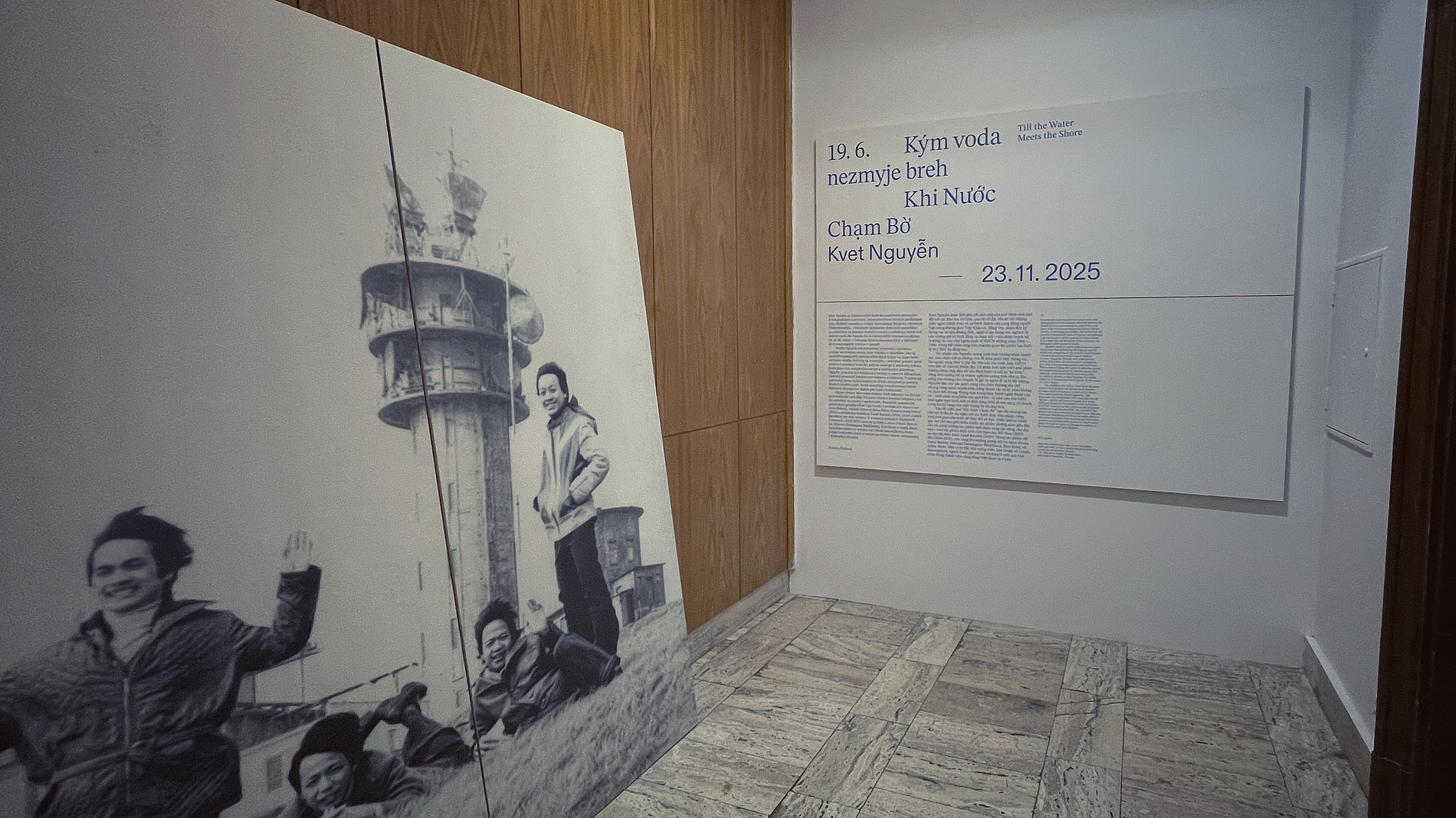
Gallery corner with a large black-and-white photographic installation leaning against a wood-paneled wall. The photo shows several smiling people posing outdoors near a tall lighthouse-like structure. On the adjacent white wall, an exhibition panel displays the title “Kým voda nezmyje breh / Khi Nước Chạm Bờ” by Kvet Nguyen with the date 23.11.2025, along with blocks of explanatory text. The floor is tiled in stone, and the space appears quiet and minimal. ©Stefanie Populorum
©Stefanie Populorum
Nguyen’s stories are told by the water and through the water.

Like water shaping a riverbank or shoreline, Nguyen’s work reveals how individual and collective histories emerge through continuous, often invisible processes. Water speaks from the distance and returns like stories that are carried across water, that dive through suppressive political systems, stories that were submerged for decades, now reaching the surface, visibility. The exhibition created a space where silenced narratives were not only recovered but allowed to resonate in the present.

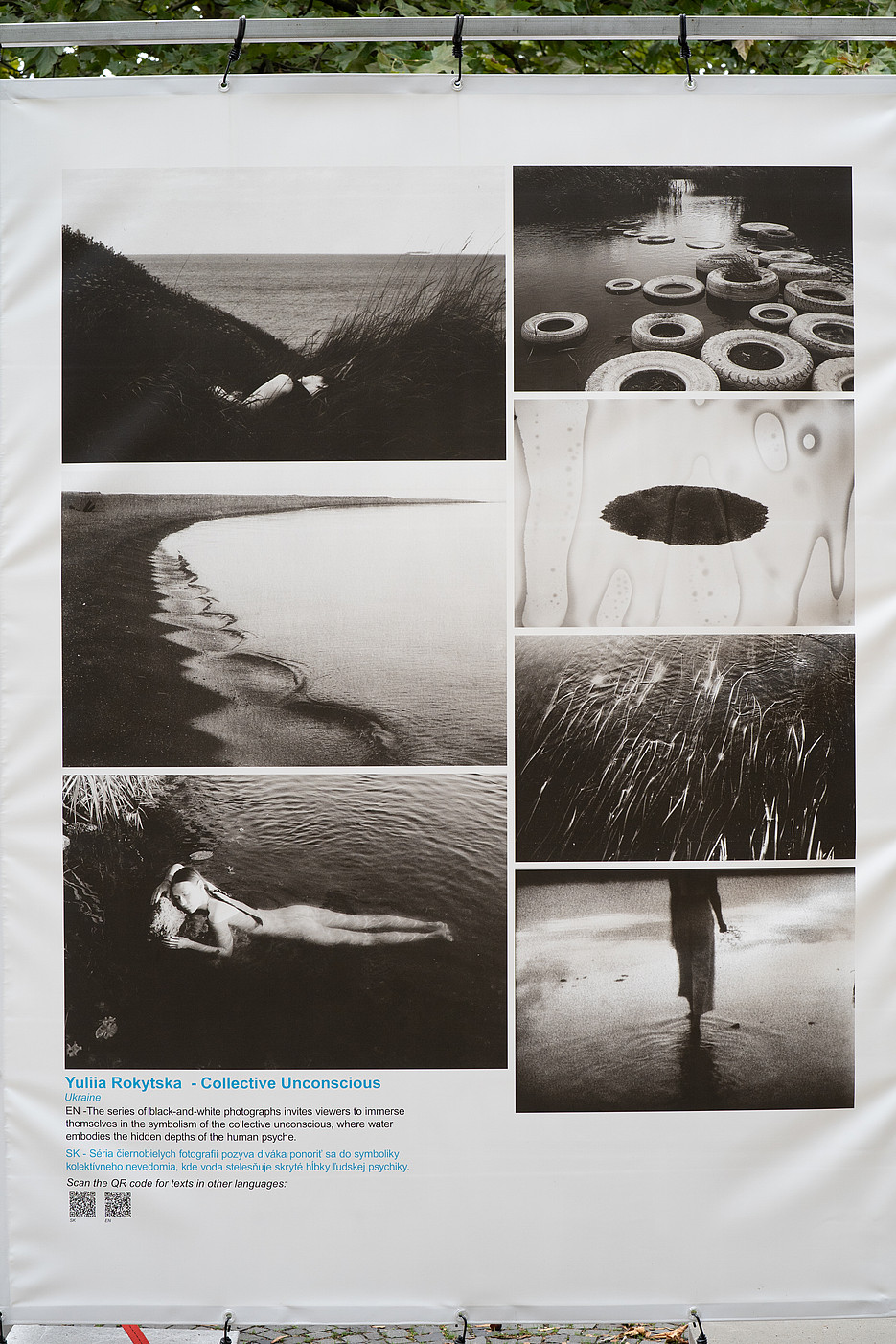
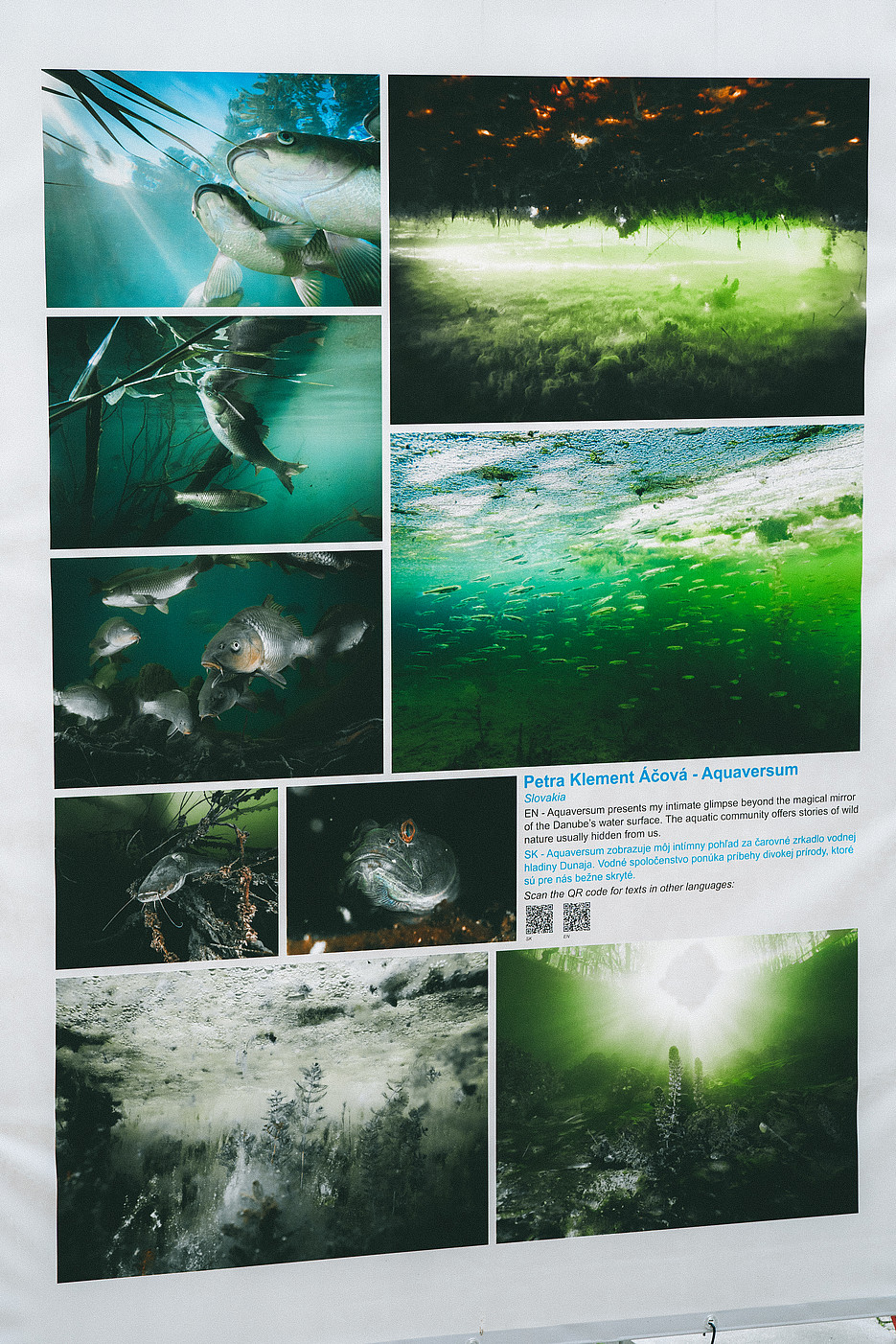
Water also met us at the Slovak Press Photo 2025 exhibition, presented in the streets of Bratislava. Through documentary photography from across the Central and Eastern European region and Ukraine, the exhibition examined water as a vital resource and a site of crisis.
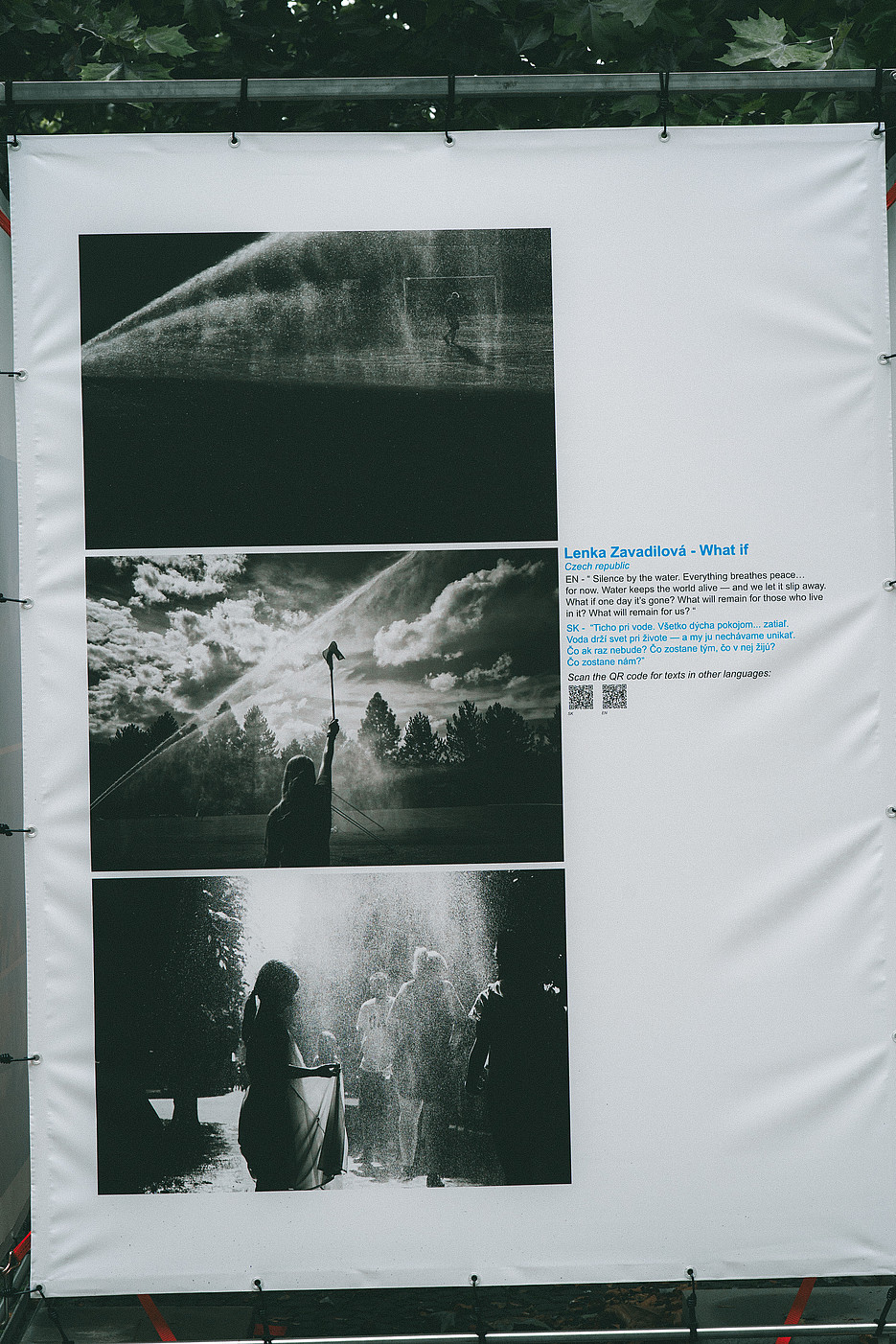
Lenka Zavadilová’s What if at the Slovak Press Photo 2025 exhibition ©Manuel Madaini
©Manuel Madaini
Lenka Zavadilová’s What if at the Slovak Press Photo 2025 exhibition
Yuliia Rokitska’s Collective Unconscious at the Slovak Press Photo 2025 exhibition ©Manuel Madaini
©Manuel Madaini
Yuliia Rokitska’s Collective Unconscious at the Slovak Press Photo 2025 exhibition

Photographs documented floods, droughts, melting ice, polluted rivers, and communities living at the edge of environmental apocalypse. Water in these images reflects urgency and vulnerability, but also resilience in human and nonhuman responses to the accelerating ecological change. Beyond its environmental focus, the exhibition Water positions rivers, coastlines, and flooded landscapes as politically and socially charged spaces. Water marks borders, enables and undercuts trade and migration, and exposes inequalities. Both exhibitions echoed my research and our FWF-funded project at the University of Graz as “Rivers in Crisis” understands waterways not merely as natural systems and part of landscapes but as subjects deeply entangled with other living beings, their history, memory, and survival.
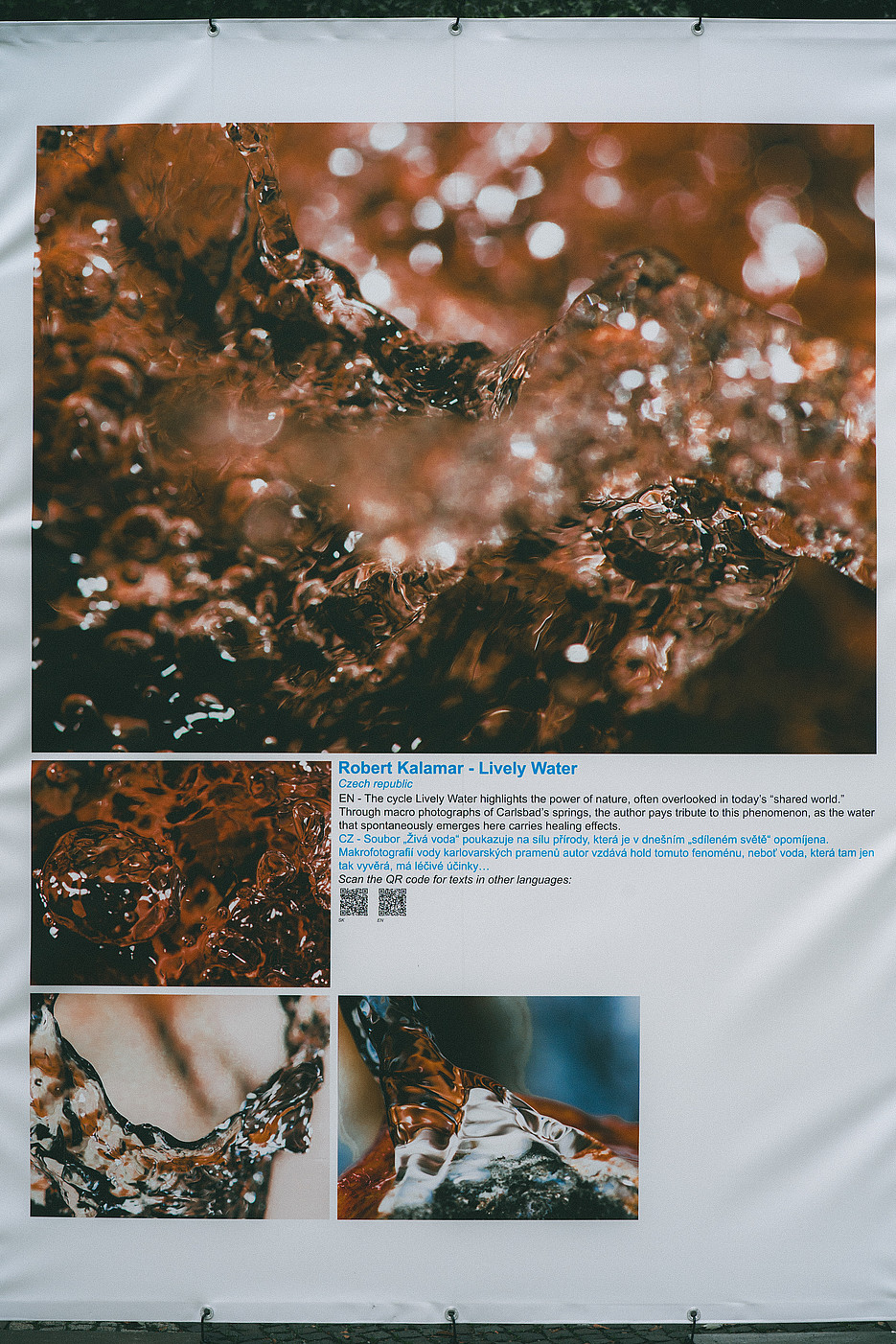
Robert Kalamar’s Lively Water at the Slovak Press Photo 2025 exhibition. ©Manuel Madaini
©Manuel Madaini
Robert Kalamar’s Lively Water at the Slovak Press Photo 2025 exhibition
Petra Klement Áčová’s Aquaversum at the Slovak Press Photo 2025 exhibition. ©Manuel Madaini
©Manuel Madaini
Petra Klement Áčová’s Aquaversum at the Slovak Press Photo 2025 exhibition

Through art, we can finally understand water as a medium of hope and connectivity. In the installations, photographs, and in Mayröckers poem, water operates as threshold between past and future, visibility and effacement. The visuals and text carry histories of displacement and extraction, but also embody relationality and renewal. In an era overshadowed by environmental crises, water becomes a lens through which we must re-think––as feminist and posthumanist scholar Donna Haraway might frame it––how we navigate space, what we consider property, and where we want to move with our planet, with our water. On this field trip from Wien to Bratislava, we encountered the river Danube not as a boundary but as a bridge from one city to another, one story to another, one verse to another: “endlich gleiten wir mit dem city liner nach Wien-/Schwedenplatz zurück.“ (Friederike Mayröcker, 15.1.2021)

Author: Stefanie Populorum

Date: 2.3.2026

Begin of page section:
Additional information:

University of Graz
Universitaetsplatz 3
8010 Graz
Austria
  • Contact
  • Web Editors
  • Moodle
  • UNIGRAZonline
  • Imprint
  • Data Protection Declaration
  • Accessibility Declaration
Weatherstation
Uni Graz

End of this page section. Go to overview of page sections

End of this page section. Go to overview of page sections

Begin of page section:

End of this page section. Go to overview of page sections