



Railways and Waterways: the Betrayed Promise of Modernity (Balkan-Adriatic Case)
Railways and Waterways: the Betrayed Promise of Modernity (Balkan-Adriatic Case)
Research in Practice
In the summer of 2026, droughts and low river levels paralysed Europe with fear and frustration. Extreme heat and a lack of precipitation revealed particularly unsettling scenes. In Central Europe, whose water imagery is inextricably tied to the river Danube, we have been witnessing surreal landscapes — such as motorcycles that Nazi forces threw into the Danube while retreating from Budapest now emerging to the surface.
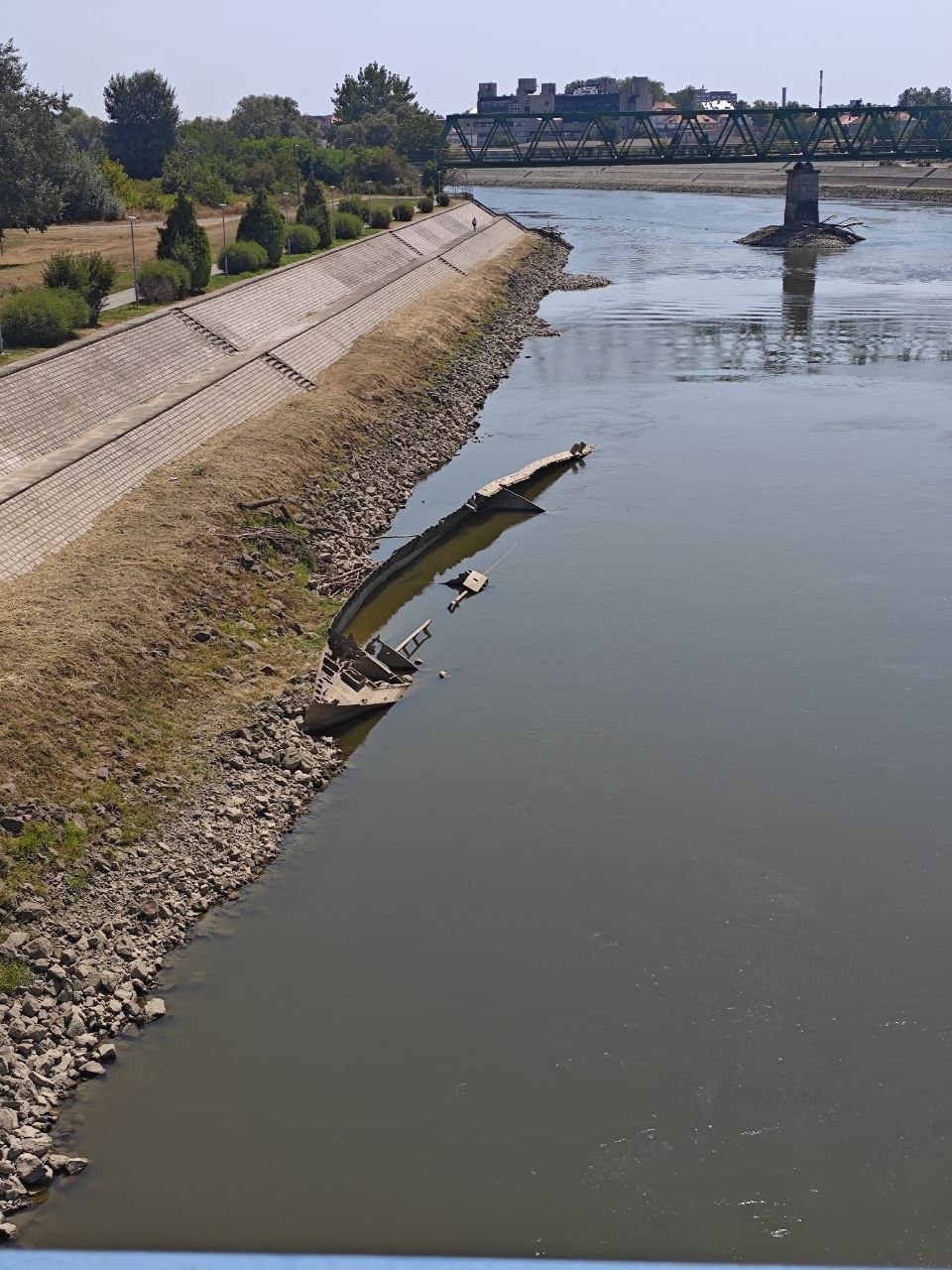
The South-Slavic realm of Central Europe exposes similar dystopian landscapes. Osijek, a town on the river Drava, near its confluence with the Danube, has also witnessed the emergence of a sunken, probably German, ship (figure 1).
In Vukovar, Croatia’s largest river port on the Danube, a tourist cruise ship was stuck for days because of extremely low water levels.
These cities, once prominent economic, educational, and cultural hubs in the region, became almost abandoned and peripheral long ago. Cruise ships in Osijek and Vukovar — even when not stranded in the harbour for days — amplify the sense of peripherality, cultural decay, and de-modernisation brought about by war, ethnic conflict, and deindustrialisation. The opulence of these ships, and the fact that such journeys serve as an ultimate status symbol, stand in stark contrast to the general inaccessibility of public transportation in this area.
Railways are slow and unreliable, while in summer the bus lines between Osijek and Vukovar — a distance of 33 kilometres — do not run on weekends.
The same limits apply to the Balkans, Central Europe’s counterpart in modern political and cultural imagery. Vibrant cities that once flourished at the crossroads of empires and lingual-cultural melting pots, such as Belgrade and Timisoara, were connected via the Danube — a waterway that a hundred years ago was affordable even for the lower classes. Today, the trip from Belgrade to Timisoara takes about four hours, with just one mediocre motorway and an exit–entry system at the European Union border that has replaced passport stamping with fingerprint and facial image collection.
Archive materials and old magazines, however, reveal a past that — when compared to the sites of climate disasters, widely accepted biometric surveillance, and systemic deindustrialisation — seems almost like a futuristic utopia.
The State Archive in Osijek holds a manuscript (written February 29, 1924) by high school student Miroslav Reichenfeld, a member of the organisation Adriatic Guard. The manuscript, entitled “My Journey Through the New Romania”, clearly refers to post-Trianon Central Europe and Romania’s territorial enlargement at the expense of territories that previously belonged to Hungary.
This short, handwritten four-page essay describes one of Timisoara’s most prominent features—even today—the number of languages heard on its streets: Hungarian, Romanian, and Serbian, a legacy of post-imperial conditions.
Perhaps the most interesting part of this manuscript, however, is the description of the return journey.
Miroslav travelled by railway from Timisoara to Vršac, a small town in the Serbian part of Banat, and from there “by boat to Belgrade.” From Belgrade to Osijek he travelled by train, something that today, unlike in 1924, is impossible. This manuscript is a testimony of its time for yet another reason. As already mentioned, this student was a member of the Adriatic Guard. The organisation emerged after D’Annunzio’s occupation of Rijeka, aiming to culturally legitimise the presence of South Slavs on the Adriatic.
Although it operated under the patronage of the ruling Karađorđević dynasty, it played an important role in cultivating and preserving anti‑imperial sentiment among all intellectual strata in the Kingdom of Serbs, Croats, and Slovenes — artists, journalists, scholars, pupils, and students. Its popularity among the masses is evident in the fact that it had branches even in parts of Yugoslavia that, like Osijek, had no direct contact with the Adriatic coast.
The Adriatic Guard was founded in 1922 in Split. By 1923, it even had a branch in Buenos Aires because the embassy there was responsible for Yugoslav emigrants in Argentina, but also in every other Latin American country (most frequently: Uruguay, Chile, and Brazil). The establishment of the Adriatic Guard in Buenos Aires actually demonstrates how large and culturally developed the Yugoslav diaspora already was.
Back then, waterways and railways were means of modernisation, carrying hope for a better life across the ocean to the most exploited social groups—peasants and toilers.
The demographics of Yugoslav emigrants can be traced through a controlled keyword search on the website of the Centro de Estudios Migratorios Latinoamericanos. Records tracked the ports where they boarded, the ships they travelled on, and their occupations (figure 2). As expected, many of these people reached the new continent from Trieste, Genoa, or Marseille, since maritime connections from Rijeka to these cities were quite solid at the time. However, many also arrived from northern ports such as Amsterdam and Hamburg.

The most frequently listed occupations include marinero, agricultor, and jornalero — sailors, farmers, and day labourers. As a philologist, I cannot help but notice how language preserves traces of modernisation: while the same root word in Italian and English refers to a “media worker,” in Spanish it denotes a labourer. Daily newspapers and day labour structured the modern relationship with time, and language preserved that.
It is particularly interesting that, in interwar Croatian literature, the destinies of these emigrants inspired writers to capture their experience as that of the global, and not only maritime, proletariat. In the interwar period, poets such as Gustav Krklec, Dragutin Domjanić, Mate Balota, and Ante Cettineo, rather than nostalgia, picture the continuity of suffering and hard labour from the South Slavic Adriatic to Punta Arenas, the world's largest southernmost city in Chilean Antarctica.
In some of these poems, it is clearly emphasised that salvation does not lie in transatlantic maritime routes but in workers’ revolution. Yet, as these examples show, rethinking the legacies of modernity from the water allows us to reconsider not only previously unexplored aspects of modernity but also the betrayed promises of modernisation that continue to shape our everyday life.
Date: 14. 8. 2026.