



Marseille’s Downtown: Where the Mediterranean City Meets the Tourist City
Marseille’s Downtown: Where the Mediterranean City Meets the Tourist City
Field Notes
Marseille’s most familiar image is perhaps that of water. The Vieux-Port and the nineteenth-century docks stretching northwards toward La Joliette open out the city onto the Mediterranean. But the sea is more than Marseille’s backdrop. It has organised the city’s economy, its built environment, its movements of people and its political imagination. Marseille was a port of empire before becoming one of Europe’s emblematic post-imperial cities, and the routes that once carried colonial goods also carried soldiers, workers, refugees, merchants and families. The city of Marseille is therefore a particularly vivid place for thinking about liminality: as both a line between land and water and a social condition produced by movement across that line.
Today another movement is transforming Marseille. Long stereotyped within France as unruly, poor or dangerous, the city has become one of the Mediterranean’s most fashionable urban destinations. International media have helped recast its image. For example, after a “36 Hours in Marseille” feature in 2019, the NYT guide returned to the city in 2025. France’s former “second city” is now sold through sea, light, markets, food, street life and an aesthetic of Mediterranean authenticity. Such is the pull of la cité phocéenne (the Phocaean City), however, that in a Guardian article Mary Fitzgerald described Marseille as France’s new capital of “overtourism,” noting that it had recently overtaken Paris and Nice as the most searched French destination on Booking.com and that visitor numbers were expected to approach seven million in 2026.
These tensions become especially clear in what Pierre Sintès and I have called downtown Marseille: Noailles and Belsunce, between Saint-Charles and the Vieux-Port and on either side of the Canebière. In our chapter “Urban Creation or Fruitful Regeneration? What Is Marseilles’ Downtown?” in The City as the Southern Question, we treat this concatenation as a hinge: between poorer north and wealthier south, railway and port, tourism and neighbourhoods still organised around everyday local commerce.
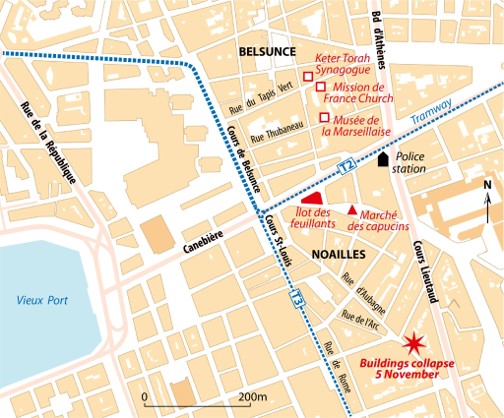
As the Marseillologues of the 1990s Émile Temime and Alain Tarrius taught us, Belsunce has long been an arrival point and a centre of trans-Mediterranean trade. In the decades after decolonisation, North African merchants made it part of commercial networks extending across Provence, North Africa and beyond. Jewish merchants from Djerba were central to its textile trade and later collaborated with Muslim economic and political migrants from Algeria and Tunisia. The small Djerban synagogue Keter Thora still survives on rue du Tapis Vert beside a Catholic church. Across the Canebière, Noailles developed a different but related ecology around the Marché des Capucins, halal butchers, North African bakeries, cafés and businesses connected to Maghrebi, Comorian, Armenian and West African Marseille. These are not just traces of migration. They are infrastructures of communal life through which Mediterranean relationships continue to be reproduced.
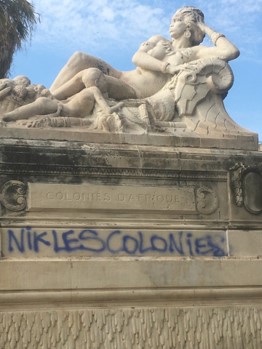
The imperial and post-imperial city also sits visibly on top of itself. Near Saint-Charles station, one of the city’s summits (the other being the Notre Dame de la Garde Basilica), a monumental figure marked “Colonies d’Afrique” commemorates the colonial Marseille built through overseas expansion. Across its base someone sprayed “Nik les colonies” (“f*** the colonies”). The two inscriptions occupied for some time, the same stone encapsulating Marseille as palimpsest: imperial grandeur, postcolonial presence and contemporary political refusal layered in a single urban object. Downtown is full of such conjunctions, even when they are less spectacular.
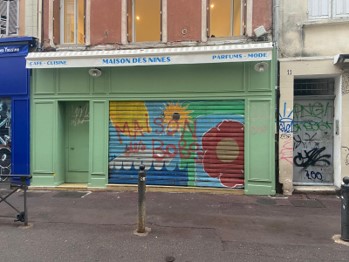
Touristification adds a new layer to Marseille’s complex make-up. In Noailles, long-established shops and inexpensive cafés increasingly coexist with organic bakeries, design businesses, fashionable restaurants, hotels and short-term rentals. On rue des Récolettes, the façade of Maison des Nines was tagged “Maison des Bobos”, using the familiar French term bourgeois-bohème to mark the arrival of culturally affluent newcomers. The slur-come-joke identifies a real tension, but not a simple one. In this sense Marseille is becoming something of a Richard Florida city: the social and cultural heterogeneity that attracts the so-called “creative class” becomes part of the very value through which neighbourhoods are reimagined and marketed. Many of these newcomers are attracted by precisely the plural, anti-bourgeois qualities that make the centre distinctive, and some are active in campaigns against displacement. At the same time, their purchasing power and desire for “authentic” urban life can help convert those qualities into economic value. The speed with which this new reality in Marseille has entered local self-description and humour is also visible in Marseille comedian Julien Vinh’s Instagram reel.
This tension is now becoming a public issue across Marseille. Recent reporting by La Marseillaise on residents of Les Goudes protesting over surfréquentation (overcrowding), and a GEO report on growing frustration with noise, rubbish, prices and Airbnb show how touristic and ecological pressures have entered local political conversation. Much of this reporting concentrates on the spectacular littoral: beaches, fishing villages, the Calanques and postcard harbours. But the less coveted “downtown” matters because it is the point at which that new Mediterranean tourism meets the older Mediterranean city.
In downtown Marseille visitors do not simply consume a waterfront landscape. They enter spaces whose desirability comes from postcolonial commercial and communal worlds that are still functioning. The Capucins market is simultaneously a working market and a visitor attraction; North African foodways are both everyday infrastructures and signs of “authentic Marseille”; streets formed through migration become objects of aesthetic discovery. The tension is therefore sharper than a conflict between tourists and locals. It concerns the conversion of forms of shared life into urban value, and the possibility that the people and networks that produced that value may eventually find it harder to remain.
The outcome is not predetermined. Downtown Marseille also has unusually strong traditions of collective urban action. Associations and residents have fought for affordable housing, transformed streets into open-air cinemas, organised shared meals, greened pavements and experimented with ways of holding space outside purely commercial logics. After the 2018 collapse of two buildings on rue d’Aubagne killed eight people, housing, municipal neglect and the right to inhabit the centre became impossible to separate from debates over regeneration. Even the despicable category “gentrifier” has become unmoored: new residents can participate in displacement while also joining older residents in resisting the wholesale privatisation and Disneyfication of the city.
For Liminal Water, Marseille’s importance lies precisely in this instability. Its liminality is geographical, because the city is formed at the Mediterranean shoreline, but also historical and social. The “downtown” concatenation of Belsunce and Noailles is a seam zone made through repeated movements between colony and metropole, North Africa and Europe, sea and land, arrival and settlement. Tourism is now another such movement. The question is not whether Marseille will remain untouched by this, it is whether this great Mediterranean city can remain a lived, communal and politically contested space while becoming a globally consumed Mediterranean destination. Downtown Marseille is where those two futures are now meeting.
Reference
Everett, Samuel S. and Pierre Sintès (2026) “Urban Creation or Fruitful Regeneration? What Is Marseilles’ Downtown?” In Ranabir Samaddar, Enrica Morlicchio and Sandro Mezzadra (eds), The City as the Southern Question: Alternative Histories of Urbanisation After Gramsci. London: Routledge, pp. 147–164. DOI.
Date: 7. 9. 2026.