



The Wealthiest Shipowner From The Adriatic And Social History Methods
Research in Practice
Political, military, and cultural histories, as well as literary histories, sometimes seem so distant from the fates of anonymous people. Those people we would consider "normal" or "ordinary", the masses. The history of "normal" as opposed to "extraordinary" has rarely been found in history textbooks or university curricula. You may have wondered how much of human history has been lost or trapped in the pages of lesser-known periodicals, newspapers, and archival records. Not because the histories of seafarers, railway workers, nannies, or emigrants are irrelevant, but because these sources were often not considered “first-class” testimonies of the past.
Social history, on the other hand, adopts the perspective of the “ordinary people.” It takes into account all sources that tell us something about the dynamics within historical communities, because it understands culture and literature as expressions that exist in a constant dialogue and exchange with various communities. That is how social history exposes the hidden networks where "common" and "remarkable" overlap. Such an example is the economic success and social reputation of Nikola Mihanović, a "Croatian Argentine businessman closely linked to the development of the Argentine merchant marine", as Wikipedia states.
In the 1901 issue of the magazine Nova iskra, we find an article about Nikola Mihanović (1845–1929), the wealthiest shipowner in Latin America, originally from Dubrovnik (then part of the Kingdom of Dalmatia). In 1968, as a young man and already a relatively experienced seafarer, Nikola Mihanović boarded a ship bound for the Pacific Ocean. He disembarked in Montevideo, Uruguay. At first, he worked for a company engaged in river transport of people and goods, and later organized his own transport by renting barges and boats, which proved quite lucrative for him. In 1895, he purchased an English company that managed river traffic on the Paraná and Paraguay rivers. This made him one of the richest men in the world of the maritime business. No individual anywhere owned more ships personally than he did.
Here is what the Nova iskra article recorded:
Among his ships, you will find an entire nomenclature from our geography. One is called Serbia, another Cetinje, a third Dubrovnik, then Bosnia, Dalmatia, Croatia, Krka, Neretva, Danube, and countless other names that remind the sailors, most of whom are our men from the coast, of their native region.
But he also owns a vast estate in Chaco, which he named Dalmatia, and several houses, the most beautiful of which is a splendid mansion in Belgrano, near Buenos Aires, where he lives with his family, two daughters and three sons.
Archival sources from the Archives of Yugoslavia show that between 1926 and 1928, he negotiated with the Embassy of the Kingdom of Yugoslavia in Argentina to purchase a building that would house the embassy. The monarchist regime in Belgrade (the capital of the Kingdom of Serbs, Croats, and Slovenes / Yugoslavia) held him in exceptionally high regard as a successful businessman and awarded him several awards for “distinguished citizens.” At the same time, his co-nationals had a different perspective on his success. They rebelled against the authorities that celebrated and rewarded Nikola Mihanović and his wealth.
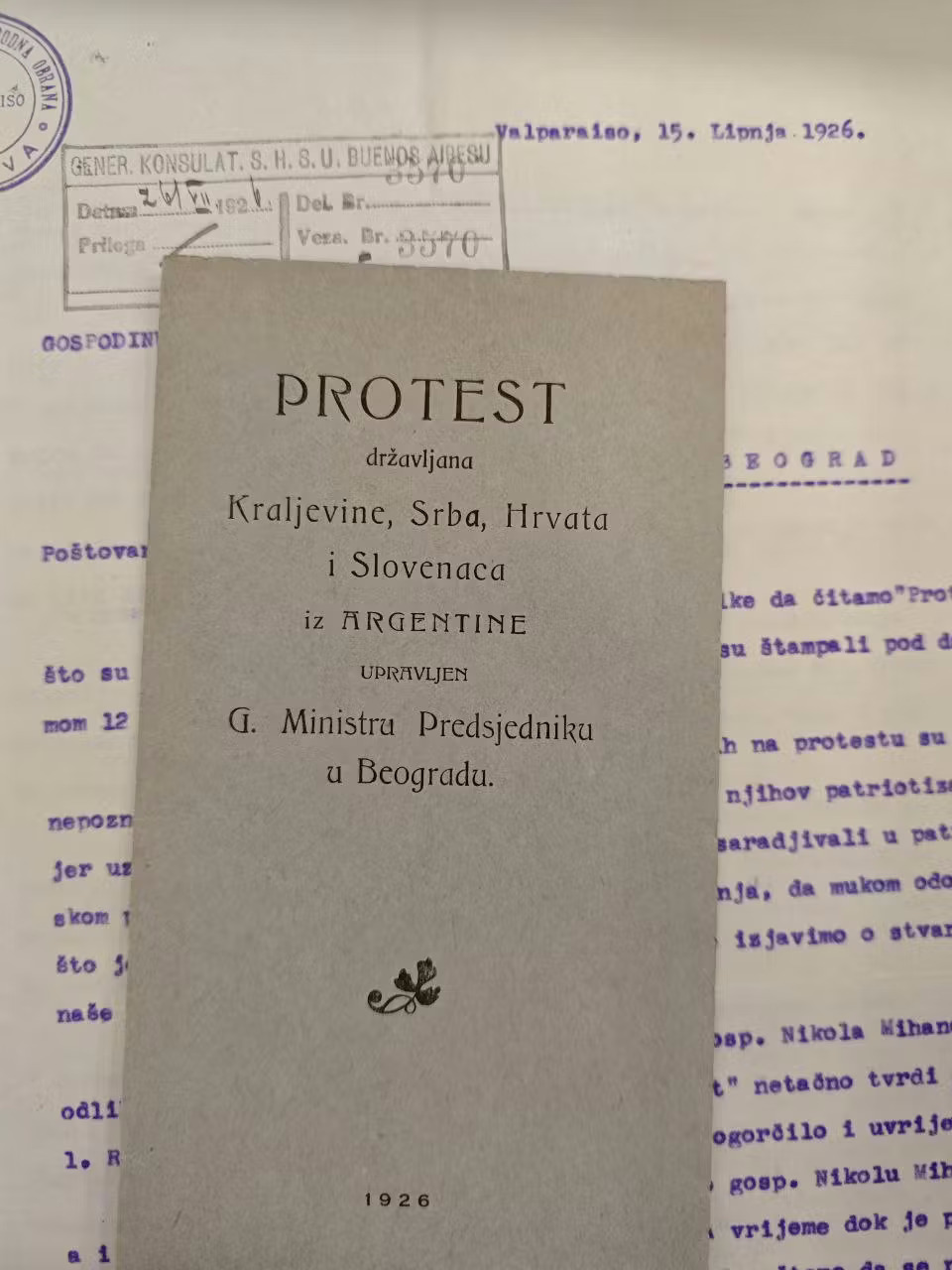
The title of the document below reads as follows:
"The protest of the citizens of the Kingdom of Serbs, Croats, and Slovenes aimed at the Minister of Foreign Affairs, from Argentina to Belgrade (1926)."
This protest was organized by the Yugoslav emigrant community against the government’s decision to award Nikola Mihanović the Order of St. Sava. This order was conferred upon both citizens and foreigners for distinguished contributions in religion, education, science, the arts, as well as in social and humanitarian work. In their letter of protest, the Yugoslav emigrant community in Argentina highlighted that Mihanović had collaborated with Austrian marine developers during World War I, thus actively undermining the struggle against Austrian imperial rule in Croatia and Yugoslavia.
The different perspectives on Nikola Mihanović’s remarkable venture in maritime history make it clear that social history does not seek merely to reveal the testimonies of “ordinary people” and oppressed groups. Rather, it describes and interprets the processes and activities — including writing and print cultures as forms of public engagement — through which these groups came to constitute themselves as collective subjects.
Author: Jelena Lalatović
Date: 16.3.2026