



Visual Ethnography in Culatra
Research in Practice
The Going with the Tide team, from Liminal Water’s Portuguese case study, is a group of anthropologists working together as filmmakers and camera and sound recorders. Working together is not only a tool for a visual and sound journey into the island of Culatra, but also a challenge to individual authorship and artistic processes. Against the (often) romanticized image of anthropologists as lonely wanderers or filmmakers as visionary artists, our team builds on our previous encounter as both anthropologists and filmmakers in the documentary film A Ramadan in Lisbon (2019, 66m, Portugal). It forecasts the possibilities of combining different artistic languages and modes of work with anthropological knowledge.
As a group of six anthropologists, we share disciplinary and conceptual backgrounds. Questions of representation, access to the field, diversity within the community, respect for people’s privacy, and their consent are extremely important and common guidelines. However, while in the field, we process and interpret actions, events, and conversations based on our own experiences, combining these with our previous (usually alone) fieldwork. Much has been written in anthropology on the role of misunderstandings (a good example is Paul Rabinow's Reflections on fieldwork in Morocco), serendipity, and collaborations between researchers and research interlocutors in ethnography. We hardly find written pieces about the shared revelations, conversations, and interlocutions among anthropologists themselves, at least while in the field.
As Isabelle Rivoal and Noel B. Salazar refer in Social Anthropology’s Young Scholars Forum “Contemporary ethnographic practice and the value of serendipity”, the shifting focus in anthropology from journeys to projects and situations in fieldwork challenges the way ethnography is performed nowadays. Academics’ projects, time availability, and publishing pressures transform what anthropology is. They call for methodological creativity. Immersive ethnography is often replaced by punctual and extended-in-time encounters, as those we have been experiencing in Culatra.
On the Going with the Tide team, we all have time-space limitations. We live more than 250 km away from Culatra, have other jobs, other academic projects, teaching obligations, and have families. Nevertheless, we have the privilege of confronting our different anthropological readings of what we live in the field. Coming from different research areas in anthropology has proven to enrich the end-of-the-day discussions and, somehow, to circumnavigate the inherently incomplete personal portraits of the island. Some of us are attentive to food circuits and practices, others to boat designs and movements, others to gender relations and age differences. Some of us prefer chaotic visual landscapes, others for the sounds of birds and planes, others prefer this or that interlocutor or character.

It is not easy to conduct fieldwork while filming, particularly considering the technicities of the process. To set up adequate colour, frame, and light in the camera. To film people working in the water. To record sound in the middle of boats’ engine noise or on windy days. Or to find out we were not recording at all. We don’t have a script. Direct observation and filming make it hard to know when to ask questions and intervene, when to be patient, and to respect silences. The renowned Brazilian documentarist Eduardo Coutinho, director of Edifício Master (2002), said in an interview: “In documentary, you never know what is going to happen. You turn on the camera, and the person you were expecting to do something does nothing, and the one you were expecting nothing from has a ten- to twenty-minute discourse. And everything is there. And you intervene. Sometimes you don’t intervene; you must decide in that moment. If you make the wrong decision, you lose. I lost things because I intervened wrongly or because I didn’t intervene at all. You are not passive. It is an encounter”.
Filming documentaries and conducting anthropological fieldwork are both encounters and mismatches. Visual ethnographies are potential objects for building an anthropological discourse through sensations. Not only as a finalised output, but also as a process. Through the unspoken, the expressive, and the embodied, it provokes the liminality of experience. Not only of those we film, and between them and us, but also among ourselves. However hard it is to do it among six people, it is a project of anthropological communality and collective apprenticeship.
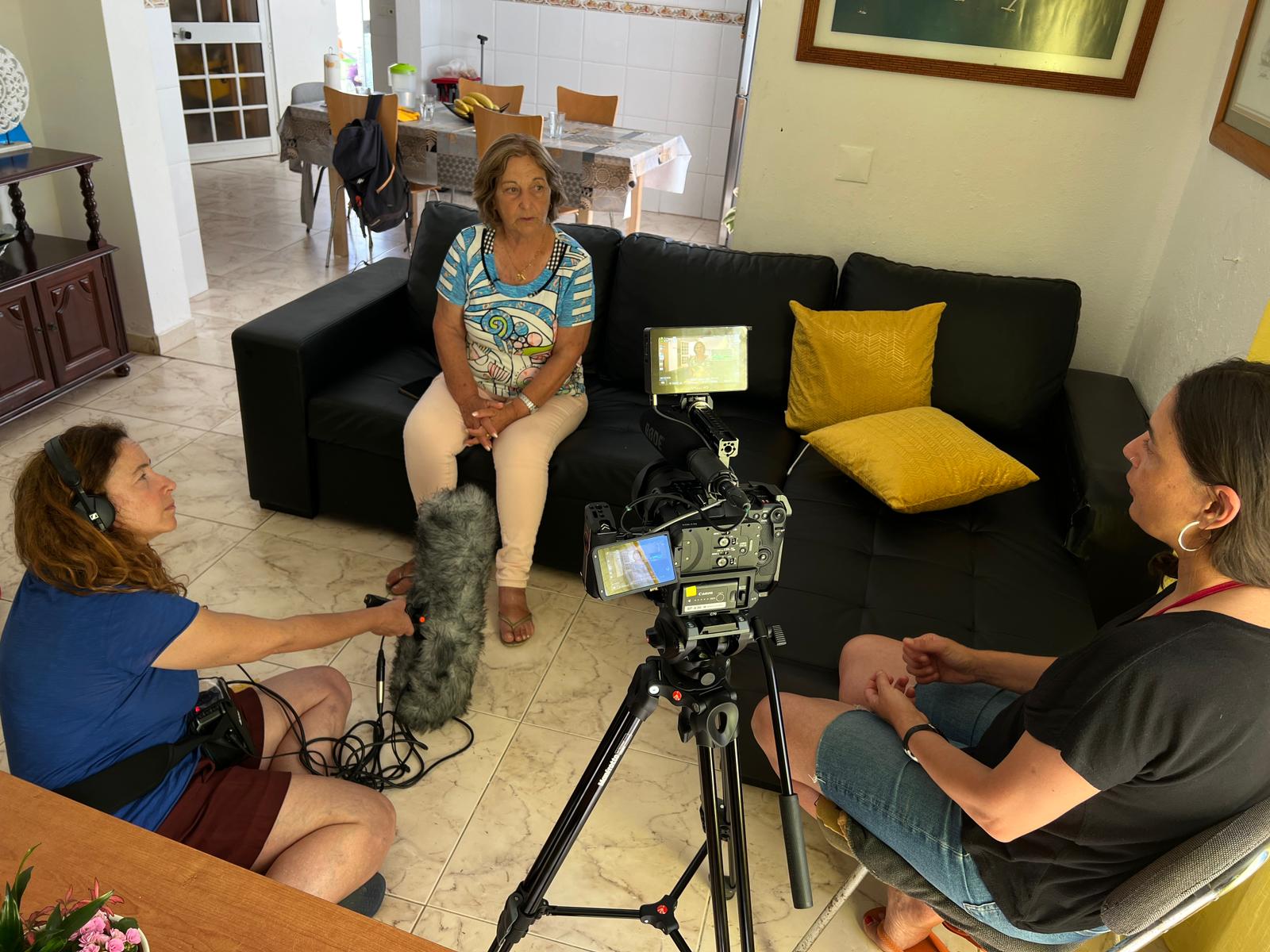
The idea of the camera as a provocation rather than a passive recording device has a long history in visual anthropology. Jean Rouch, the French filmmaker and anthropologist whose work in West Africa in the 1950s and 1960s transformed ethnographic cinema, argued that the camera does not simply capture reality; it helps call reality into being. His practice of filming with a lightweight camera in the midst of events, without a script, and allowing the presence of the apparatus to alter what it documented, resonates strongly with our own experience in Culatra. Rouch called this “shared anthropology”: a process in which filmmaker and subject co-produce knowledge rather than one simply observing the other. What interests us here is how much more complex this becomes when the filming team itself is multiple, when there is no single anthropologist’s gaze, but several, each turning the lens differently and being transformed by it in return.
In our team, the camera changes hands. Each person who holds it brings a different sensibility regarding what is worth framing, a different instinct for distance and proximity, and a different sense of what matters. The resulting footage is heterogeneous, sometimes even dissonant. A sequence filmed by one of us often has a quality another would never have sought. Does this mean that the eye of the film itself “goes with the tide”? Perhaps. Or perhaps it makes visible the plurality of ways in which anthropological attention can be framed. In this sense, our work in Culatra has also become a form of collective apprenticeship in perception. To film together is to learn from one another’s hesitations, intuitions, mistakes, and framings. It means accepting that what becomes significant in the field may shift as impressions and footage are exchanged. Collaborative visual ethnography, then, is also a practice of learning to perceive differently.

Collective fieldwork also means carrying one another affectively. The end-of-day conversations mentioned before are not only intellectual exchanges; they are emotional ones as well. Someone is frustrated by an interaction that went badly. Someone is excited by something they filmed that the others did not witness. Someone is worried about whether a person we have been following has given us trust or merely tolerance. These conversations take place in rented rooms, over late dinners, sometimes in the car on the way back. They are themselves situated ethnographic events, encounters that will shape the film as surely as any scene recorded on camera. They are where individual experience becomes collective understanding. We do not have a formal method for conducting them, and at times we have wondered whether we should. For now, they remain what they are: difficult, partial, necessary, and unlike anything we experience when working alone.
But ethnography is never truly solitary; we are always with others in the world. Sarah Pink, in her book Doing Sensory Ethnography, argues that fieldwork is not primarily about collecting data but about attunement, learning to sense an environment as others sense it. The movement of hands sorting oysters, the curved posture of someone gathering shellfish for hours, or the precarious coordination of bodies on a boat crowded with fishing equipment and animals may all become analytically significant. Through the lens, gestures, pauses, bodily techniques, and relations with material environments acquire another kind of weight.
This attunement is not only visual. It involves the skin, the inner ear, the body’s adjustment to heat and cold, wetness and wind. When we describe the challenge of recording sound on a windy day by the water, we are also describing an encounter with the island’s sensory world as it imposes itself, sometimes almost mercilessly, on our bodies, cameras, and microphones. Culatra reaches us as a texture of salt, the violent reflection of light on water and sand, the pitch of seagulls above the boats, the clinking of glasses and cutlery in one of the restaurants. Wind, engines, birds, the air escaping from the sand as the tide rises, TV sound spilling from houses at dinnertime, and the distant but constant presence of airplanes all shape how the island is inhabited and perceived. So, too, does the absence of cars. On Culatra, sound is itself an argument. Visual ethnography, in this sense, may even be a misnomer. What we are trying to do is closer to a sensory ethnography that happens to be recorded partly on camera: an embodied exploration of what it feels like to be in a place.
Authors: Raquel Carvalheira and Rodrigo Lacerda
Date: 20.4.2026